
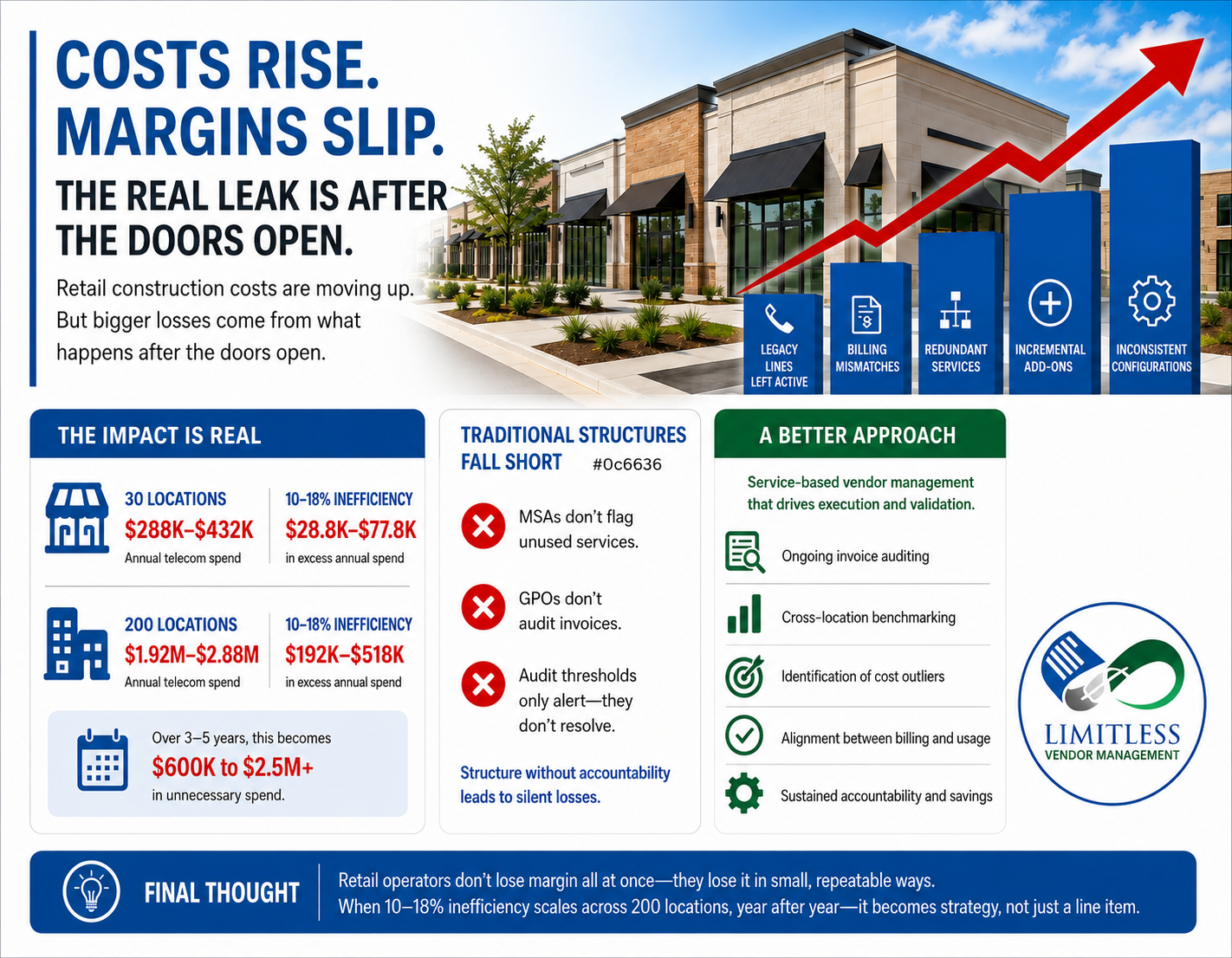
Retail construction costs are moving up—but not in a way that grabs headlines. It’s gradual. Persistent. Easy to rationalize in isolation. What’s harder to see is how those rising costs intersect with something more controllable: operational inefficiency. Because for most multi-location retail operators, the real issue isn’t just what it costs to build—it’s what happens after the doors open. The familiar operation playbook still has value—but also blind spots Most organizations already have cost-saving playbooks in place:
- MSAs to standardize pricing
- GPOs to create buying leverage
- Some form of auditing threshold (Let’s say $500 over current billing)
These tools establish baseline economics—but assume negotiated savings and threshold alerting translate into realized savings. In practice, that’s not always the case. A quieter problem: recurring service drift The silent killer always happens AFTER the procurement process is also the hardest to control cost creep at the locations themselves. It is an area everyone is responsible for, but not any level’s priority to constantly monitor. Take internal telecom and phone services—the ongoing infrastructure that keeps retail construction locations running. Cost Impact across a 30-location retail group:
- $800–$1,200 per month per location
- $288K–$432K annually
Common inefficiencies include:
- Legacy lines never disconnected
- Billing rates misaligned with contracts
- Redundant services layered over time
- Incremental add-ons without visibility
- Inconsistent configurations
At a 10–18% inefficiency range:
- $28,800 to $77,760 in excess annual spend (30 locations)
Scaling the impact to 200 locations Annual telecom spend:
- $1.92M–$2.88M
10–18% inefficiency results in:
- $192,000 to $518,400 in avoidable annual cost
Over 3–5 years, this becomes $600K to $2.5M+ in unnecessary spend. Where traditional structures fall short MSAs don’t flag unused services. GPOs don’t audit invoices. They create structure—but not ongoing accountability. Audit thresholds TELL you there is a potential problem but being aware and having the time and resources to identify and address a problem are two entirely different things. A different approach: service-based vendor management This approach focuses on execution and validation:
- Ongoing invoice auditing
- Cross-location benchmarking
- Identification of cost outliers
- Alignment between billing and usage
Why this matters now Rising costs are forcing operators to look beyond CapEx into recurring OpEx inefficiencies. However, adding internal headcount to address operational inefficiency in a time of rising costs simply is not an option. With this, a strategy of reaching out to an expert outsourced solution can help you control these cots faster, without the impact Final thought Retail operators don’t lose margin all at once—they lose it in small, repeatable ways. When 10–18% inefficiency scales across 200 locations, year after year—it becomes strategy, not just a line item.