
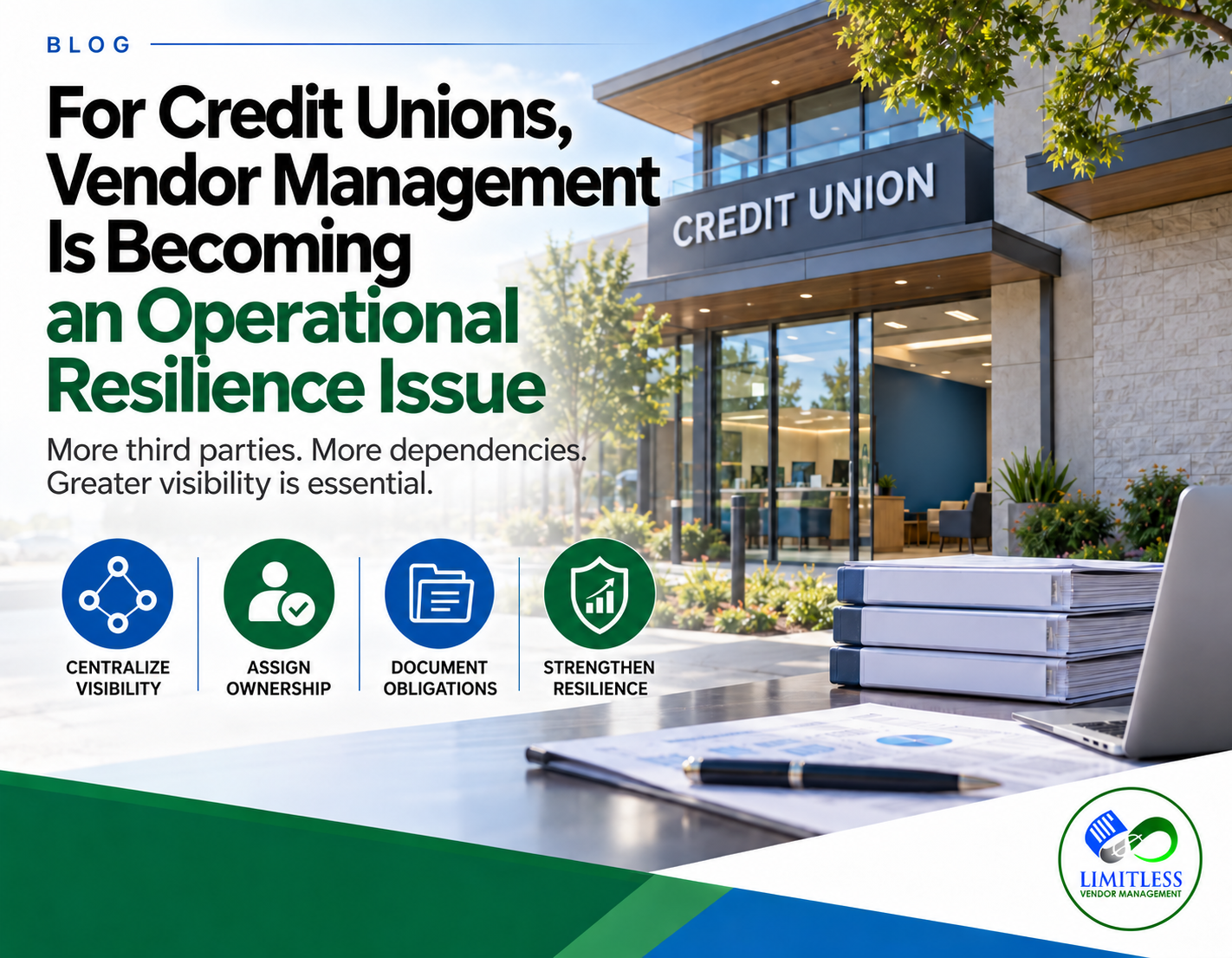
For years, third-party vendor management could be treated primarily as a procurement or compliance function.
In 2026, that’s becoming increasingly difficult—particularly for credit unions.
The National Credit Union Administration’s 2026 Supervisory Priorities explicitly identifies operational risk management as an area of attention. Within payment systems, NCUA points to increasingly complex integrations among applications, information systems, security features and internal controls.
The agency specifically states that examiners will assess whether credit unions maintain effective governance, risk assessments, vendor management and security frameworks supporting payment operations.
That’s an important distinction.
Vendor management isn’t simply about what you’re paying anymore.
It’s increasingly connected to whether the institution can operate safely and reliably.
The modern credit union depends on an ecosystem.
Consider how many external relationships support a financial institution.
- Telecom providers.
- Internet connectivity.
- IT services.
- Security.
- Payment technologies.
- Facility vendors.
- Cloud and software providers.
- Utilities.
- Document management.
- Maintenance services.
Each relationship creates its own combination of pricing, service obligations, documentation, renewal dates and operational dependencies.
The larger that ecosystem becomes, the harder it is to answer seemingly basic questions:
- What do we have?
- What are we contractually entitled to receive?
- When does it renew?
- Is the vendor delivering it?
- Who internally owns the relationship?
The regulatory direction is clear.
Existing interagency banking guidance emphasizes lifecycle management of third-party relationships—including planning, due diligence, contracting, ongoing monitoring and termination.
It also emphasizes maintaining an inventory of third-party relationships and tailoring oversight based on risk.
For credit unions, NCUA similarly says due diligence should consider the critical nature of the service, vendor expertise, economic and regulatory changes and associated risk-mitigation strategies.
That turns contract organization from administrative housekeeping into part of institutional governance.
But risk and cost shouldn’t live in separate conversations.
Financial institutions sometimes treat vendor risk and vendor cost as independent disciplines.
They aren’t.
A poorly managed contract can simultaneously create:
- financial exposure,
- service risk,
- documentation gaps,
- unfavorable renewal provisions,
- billing discrepancies,
- unclear accountability.
The better question isn’t simply, “Can we negotiate this vendor lower?”
It’s:
“Are we receiving the value, protections, service and accountability we’re paying for?”
That is a much more strategic definition of vendor management.
The takeaway
Credit unions don’t necessarily need fewer third-party relationships.
They need greater visibility into the relationships they already have.
As financial institutions become more technology-dependent and interconnected, centralized contract oversight, documented accountability and continuous vendor monitoring become increasingly important parts of operational resilience.
In other words:
Knowing your vendors is becoming as important as negotiating with them.
If an examiner or executive asked today which third parties support critical operations, where the governing contracts are located, when they renew, who owns each relationship and whether performance is being monitored—how quickly could your organization answer?
Limitless can help assess the operational side of your vendor environment: contract organization, documentation, accountability, renewal oversight and vendor performance.
Sources: NCUA 2026 Supervisory Priorities · NCUA Third-Party Relationship Guidance · Federal Reserve Interagency Third-Party Guidance