
The Executive Myth
Artificial intelligence has become one of the largest technology investments in modern business.
Executives are told AI will increase productivity, improve forecasting, identify cost savings, and accelerate decision-making.
Many organizations are discovering a different reality.
The problem isn’t the intelligence.
It’s the data.
Dirty Data Is an Enterprise Problem
“Dirty data” isn’t simply inaccurate information.
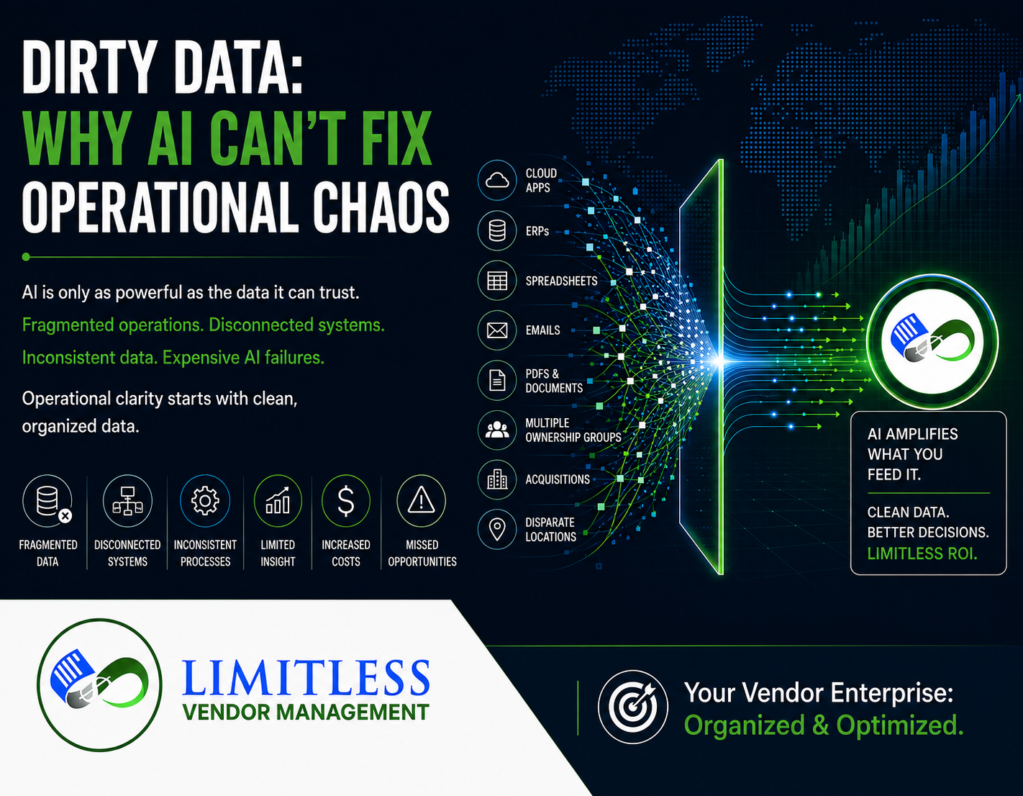
It’s operational data that has become fragmented through years of growth, acquisitions, changing ownership structures, decentralized decision-making, and disconnected technology.
For many large organizations, there isn’t one version of the truth.
There are dozens.
One region classifies vendors differently than another.
One acquisition retains its legacy ERP while another migrates to a new accounting platform.
Invoices are coded differently across business units.
Contracts live in email inboxes, shared drives, PDFs, or filing cabinets.
Operations teams measure vendor performance differently than finance.
Every system tells a story.
Unfortunately, they’re often different stories.
Why Scale Creates Complexity
The larger an organization becomes, the more difficult data standardization becomes.
Private equity firms inherit multiple operating companies.
Healthcare systems acquire independent facilities.
Restaurant groups purchase regional brands.
Senior living operators expand through management agreements and joint ventures.
Manufacturers grow through acquisitions across different markets.
Each expansion introduces:
- Different ownership groups
- Different investors
- Different technology platforms
- Different operational processes
- Different reporting standards
- Different vendor relationships
- Different financial coding structures
These aren’t signs of poor leadership.
They’re the natural byproduct of growth.
But they create an environment where operational data slowly loses consistency.
Why AI Doesn’t Solve the Problem
Many organizations believe AI will connect these fragmented environments.
In reality, AI first has to understand them.
Before AI can identify savings, forecast performance, or recommend decisions, it must reconcile thousands of inconsistencies across systems that were never designed to communicate with one another.
That means organizations spend enormous amounts of time and money:
- Building integrations
- Cleaning historical records
- Standardizing naming conventions
- Mapping duplicate vendors
- Reconciling financial data
- Maintaining hundreds of system connections
Ironically, many AI initiatives become data-cleaning initiatives.
The technology works.
The data doesn’t.
The Cost Few Organizations Anticipate
This is why enterprise AI projects often exceed expectations—not because the models fail, but because organizations underestimate the operational complexity beneath them.
Every disconnected system creates another integration.
Every acquisition introduces another layer of reconciliation.
Every inconsistent process requires another rule, another connector, another exception.
As organizations grow, the cost of maintaining data often grows faster than the value AI can immediately produce.
The Organizations Seeing the Greatest ROI
The companies generating the strongest return on AI didn’t start with artificial intelligence.
They started with operational discipline.
They standardized vendors.
They centralized contracts.
They established governance around financial coding.
They created consistent operational processes.
Most importantly, they built a trusted foundation of enterprise data.
Only then could AI move beyond organizing information and begin generating meaningful insights.
The CFO Perspective
For finance leaders, dirty data isn’t an IT issue.
It’s a profitability issue.
Every inconsistent vendor record, disconnected contract, duplicate payment, and fragmented reporting process increases operational cost while reducing confidence in executive decision-making.
Before organizations ask how to become AI-enabled, they should ask a more fundamental question:
Can our business speak one operational language?
Because AI doesn’t create operational excellence.
It accelerates whatever operational foundation already exists.
Organizations with clean, standardized data will move faster, forecast more accurately, and realize greater returns on technology investments.
Those with fragmented data will simply automate complexity.
And complexity is rarely profitable.