
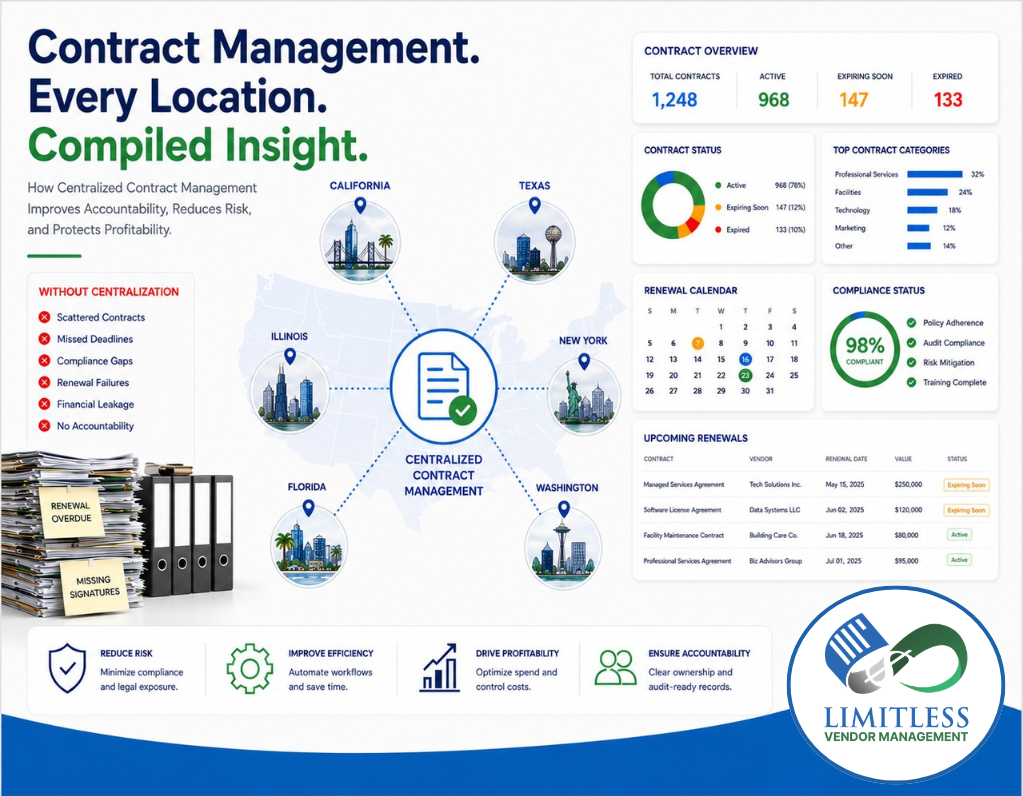
For many organizations, vendor contracts are viewed as administrative documents—signed, filed away, and revisited only when a problem arises. In today’s operating environment, that mindset is becoming increasingly expensive. Across the United States, business leaders continue to face pressure from rising operating expenses, labor constraints, evolving compliance requirements, and heightened expectations around profitability. While much attention is paid to revenue growth and labor management, one of the most overlooked areas of operational risk remains hidden inside vendor contracts and the systems used to manage them. The challenge is not simply negotiating a favorable agreement but retaining, organizing, monitoring, and enforcing those agreements long after the signature page is complete.
The Contract Isn’t the Finish Line
Many organizations invest significant effort negotiating pricing, service levels, and terms during procurement. Yet months—or years—later, those same contracts become difficult to locate, renewal dates are missed, amendments are scattered across email chains, and institutional knowledge disappears when personnel change. The result is a common operational reality:
- Autorenewals occur without review.
- Service levels go unmeasured.
- Pricing increases receive little scrutiny.
- Documentation becomes fragmented.
- Vendor accountability gradually erodes.
None of these issues typically create an immediate crisis. Instead, they create a slow and often invisible drain on operational performance.
Accountability Requires Documentation
Vendor accountability is impossible when organizations cannot quickly access the documents that define expectations.
Service agreements, pricing schedules, insurance certificates, amendments, performance guarantees, and termination clauses are not merely legal records, they are operational tools. Without centralized retention and oversight, organizations often find themselves asking:
- What pricing did we originally agree to?
- Is this rate increase contractually allowed?
- Has the vendor met its service obligations?
- When does this agreement expire?
- What notice period is required before renewal?
If those answers cannot be obtained quickly, the vendor often holds the informational advantage. Over time, that imbalance can impact costs, service quality, and negotiating leverage.
The Cost of “Set It and Forget It”
The most significant vendor-related losses rarely come from a single catastrophic event. Instead, they emerge from years of small issues that go unnoticed:
- Gradual rate increases.
- Unused services that remain active.
- Contract provisions that no longer fit operational needs.
- Missed opportunities to benchmark pricing.
- Inconsistent service performance across locations.
For multi-location operators, these issues compound quickly. A small monthly overcharge or underperforming service agreement multiplied across dozens—or hundreds—of locations can create meaningful financial impact over time. The organizations that consistently outperform their peers are often not the ones negotiating the lowest price. They are the ones maintaining visibility and accountability after the contract is signed.
Vendor Relationships Still Matter
Accountability should not be confused with adversarial vendor management. The strongest vendor relationships are built on clear expectations, transparent communication, and mutual accountability. Good vendors benefit when expectations are clearly defined and documented. Strong vendor partners generally welcome structured performance reviews, organized communication channels, and well-maintained documentation because it reduces confusion and strengthens the relationship. The objective is not to challenge vendors unnecessarily. The objective is to ensure that agreements remain aligned with business needs and that both parties fulfill their commitments.
The Shift Toward Continuous Vendor Governance
Leading organizations are increasingly moving away from periodic contract reviews and toward continuous vendor governance. This approach includes:
- Centralized contract repositories.
- Renewal and compliance tracking.
- Performance monitoring.
- Invoice-to-contract validation.
- Vendor scorecards and accountability reviews.
- Regular benchmarking of pricing and service levels.
Instead of reacting when a problem appears, organizations establish a framework that identifies issues before they become costly. The result is improved transparency, reduced risk, and stronger operational control.
Looking Ahead
As economic conditions continue to place pressure on margins, organizations will likely face growing expectations to do more with existing resources. That reality makes contract retention and vendor accountability more important than ever—and a critical competitive advantage for organizations seeking to protect margins, strengthen vendor performance, and maintain operational control across every location. According to World Commerce & Contracting (WorldCC, formerly IACCM), organizations lose approximately 8–9% of annual revenue or contract value due to ineffective contract management, including missed obligations, unmanaged renewals, and poor contract visibility. At the same time, Deloitte notes that many organizations lack mature post-signature contract management processes, making it difficult to monitor vendor performance, enforce contractual obligations, and capture the full value of executed agreements. Together, these gaps create significant operational, financial, and compliance risks.
The question is no longer whether businesses have vendor contracts. The question is whether they have a process to actively manage them. Organizations that treat contracts as living operational assets—not static legal documents—position themselves to reduce risk, improve performance, and create long-term value from every vendor relationship.
Because the true value of a contract isn’t what was negotiated on the day it was signed. It’s what is enforced, monitored, and managed every day afterward.