
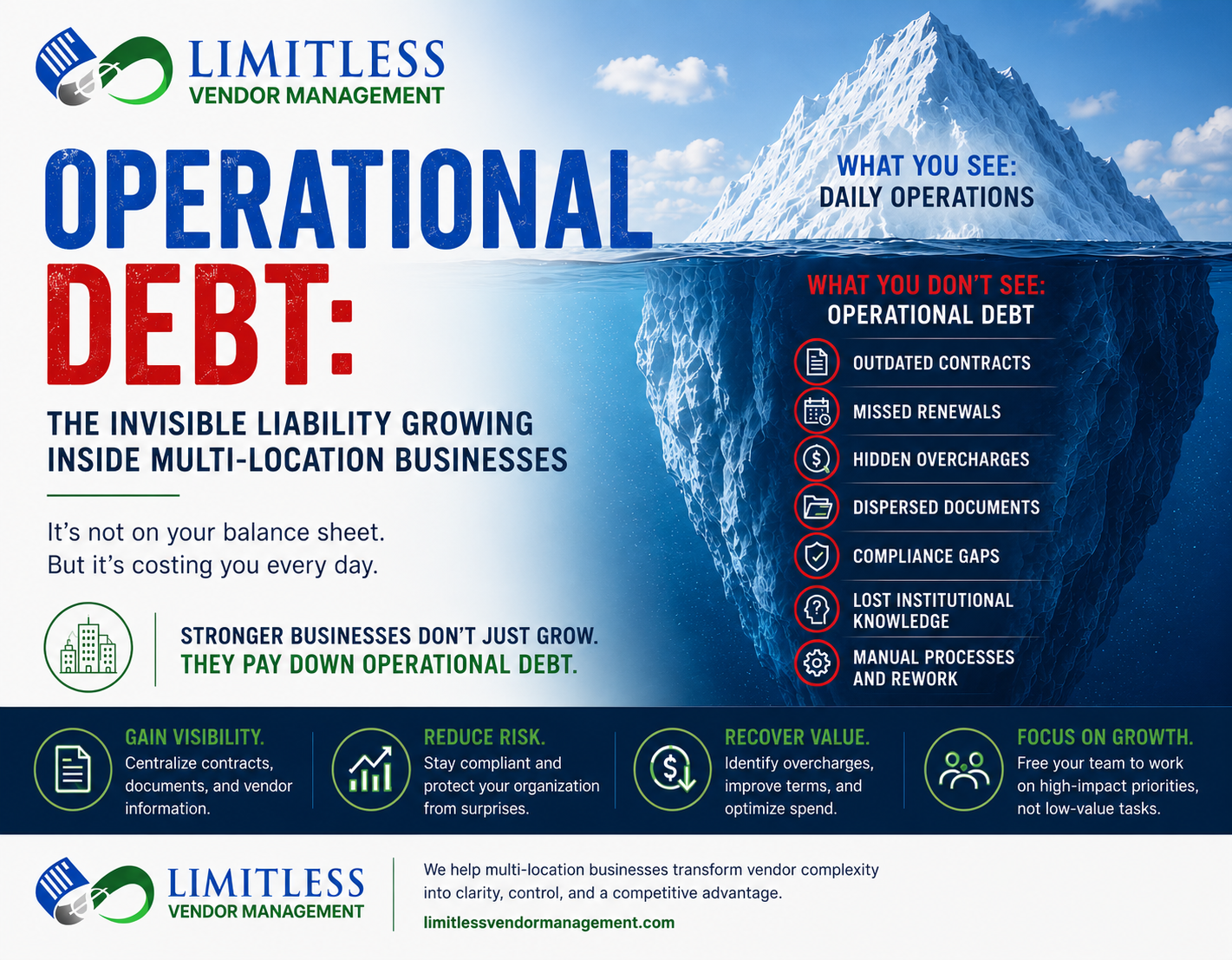
Why the next operational risk isn’t in your balance sheet—it’s hiding in your vendor ecosystem.
For years, executive teams have become increasingly fluent in two types of organizational debt.
Financial debt is measured on every balance sheet.
Technical debt has become a familiar concept in IT, describing the long-term cost of delaying technology improvements.
But there’s a third form of debt quietly accumulating inside organizations that rarely appears on executive dashboards.
Operational debt.
Unlike financial or technical debt, operational debt isn’t created through borrowing money or outdated software. It accumulates gradually through overlooked processes, fragmented information, and decisions that seem insignificant on their own but become increasingly costly over time.
For multi-location organizations, one of the largest contributors to operational debt is vendor management.
What Is Operational Debt?
Operational debt is the accumulated burden created when essential business processes become increasingly difficult to manage, monitor, or improve.
It doesn’t happen because organizations are poorly managed. It happens because successful organizations GROW all at once.
New locations open. Departments become more specialized. New vendors are added. Contracts are renewed. Employees change roles. Technology platforms evolve. Each individual decision makes sense.
Collectively, they create an environment where no single person has complete visibility and, over time, complexity becomes the norm.
Where Vendor Management Creates Operational Debt
Every organization relies on third-party vendors to keep operations running…
- Telecommunications.
- Utilities.
- Waste services.
- Facilities maintenance.
- Security.
- Landscaping.
- Laundry.
- Uniforms.
- Technology providers.
Most organizations don’t struggle because they have the wrong vendors. They struggle because the information surrounding those vendors becomes fragmented over time.
- Contracts are stored in different locations.
- Pricing amendments live inside email threads.
- Certificates of insurance expire unnoticed.
- Service agreements are inherited from previous leaders.
- Renewal dates depend on someone’s calendar reminder.
- Invoice reviews become less frequent as workloads increase.
None of these issues creates an immediate crisis. Together, they create operational debt that compounds every year.
Leaner Organizations Are Increasing the Risk
Many organizations continue operating with leaner teams while investing in automation and artificial intelligence to improve efficiency. At the same time, institutional knowledge is becoming increasingly concentrated among fewer employees. As workforce transitions occur, undocumented operational knowledge becomes easier to lose and harder to replace.
Vendor management is particularly vulnerable to this challenge.
Often, the person who understands why a contract was negotiated a certain way, which vendors require additional oversight, or where critical documentation is stored is also the person carrying numerous other responsibilities.
When that knowledge leaves with an employee, organizations often discover that the documentation alone doesn’t tell the full story.
Technology can organize information. It cannot recreate undocumented business history.
Operational Debt Doesn’t Show Up Until It Matters
Unlike financial losses, operational debt accumulates quietly. It often becomes visible only when organizations encounter significant events such as:
- A major acquisition
- Expansion into new markets
- Leadership transitions
- Vendor disputes
- Compliance reviews
- Insurance claims
- Budget reduction initiatives
During these moments, executives need immediate access to contracts, historical pricing, renewal obligations, and vendor performance. Organizations with mature vendor governance can respond confidently. Organizations carrying years of operational debt often spend valuable time searching for information instead of making decisions.
The Organizations Pulling Ahead Think Differently
Current business headlines continue to focus on inflation, trade policy, artificial intelligence, workforce efficiency, and economic uncertainty. Yet the organizations navigating these challenges most effectively often share a common characteristic.
They don’t treat vendor management as an administrative function. They treat it as operational infrastructure.
Just as finance departments continuously manage capital and IT teams continuously manage technology, leading organizations are beginning to apply the same discipline to their vendor ecosystems. That means creating visibility across contracts, standardizing documentation, monitoring vendor performance, reviewing recurring expenses, and ensuring accountability long after agreements are signed.
The objective isn’t simply reducing costs. It’s reducing complexity.
Paying Down Operational Debt
Like financial debt, operational debt grows more expensive the longer it remains unaddressed.
The good news is that it can also be reduced through deliberate, consistent governance.
Organizations that centralize vendor documentation, monitor contract obligations, audit recurring invoices, and establish clear ownership over vendor relationships often gain benefits that extend well beyond cost savings.
They improve decision-making.
They reduce organizational risk.
They accelerate acquisitions and expansions.
They strengthen compliance.
They free internal teams to focus on strategic initiatives rather than administrative recovery efforts.
…Perhaps, most importantly, they create resilience.
A Different Way to Think About Vendor Management
Vendor management has traditionally been viewed as a procurement activity or a cost-reduction initiative.
Those outcomes remain important.
But they are no longer the whole story.
For multi-location organizations, vendor management has become an operational discipline that influences financial performance, organizational agility, compliance, and executive decision-making.
The organizations that recognize this shift won’t simply have better vendor contracts.
They’ll carry less operational debt than their competitors.
And in today’s business environment, that may become one of the most valuable competitive advantages they have.
At Limitless Vendor Management, we believe vendor oversight is about much more than negotiating lower rates. We help multi-location organizations reduce operational debt by centralizing vendor information, strengthening contract governance, improving compliance, auditing recurring expenses, and creating the visibility leaders need to make informed decisions. The result is a more resilient organization where vendors become a strategic advantage instead of an operational burden.